
Introducing the RISC™ Report: the ‘credit score’ of rental income
RISC™ Explained
Let’s start with the name. RISC is an acronym that stands for Rental Income Stability Composite.
Rental: the RISC product was developed specifically for 1-4 family residential rental properties. Data and Development was focused on rental income, not equity generation (appreciation).
Income Stability refers to the stability of rental income generation of a residential real estate investment property. Income Interruption Risks are risks and events that can disrupt this rental income generation. A few examples of Income Interruption Risks include: evictions, non-payment of rent (credit loss), vandalism, frequent tenant turnover, and extended vacancies. Income interruption risks have a profound impact on the overall financial performance of rental properties. The RISC products quantify that risk. Think of the RISC Score as a ‘credit score’ for rental property income.
Composite: developing a single metric to convey rental income stability risk required the evaluation of thousands of data points. The RISC products incorporate a wide array of information across multiple data sectors. This data has demonstrated a significant influence and correlation on historical rental income stability of residential investment properties. Housing, economic, and other neighborhood-level data are utilized in the formulation of this rental income-focused product.
The RISC products are developed at the neighborhood level for every census tract in the United States.
RISC Index
The Rental Income Stability Composite (RISC™) Index uses a range of 0 to 100. A low numeric index indicating a low level of income stability and a high numerical index indicating a high level of rental income stability. The RISC Index is developed for EVERY census tract in the United States using two. comparative sample sizes, the MSA and the United States.
- MSA RISC Index: this numeric index is developed using data at the neighborhood level and then compared to all other neighborhoods in the Metropolitan Statistical Area (MSA) in which that neighborhood resides. This allows Users to compare one neighborhood against another when evaluating properties in the same MSA.
- USA/National RISC Index: this numeric index is developed using data at the neighborhood level and then compared to all other neighborhoods in the entire United States. This allows Users to compare one neighborhood against another when evaluating properties across the country.

RISC Score
Using the data found in the RISC Index, the RISC Score uses a scale similar to that of the universally-recognizable Credit Score, it uses a range of 380 to 820. In fact, you could even think of the RISC Score as a Rental Property Income Credit Score; they’re that similar in concept. Through the painstaking task of data aggregation and analysis, the past performance of rental properties is used to make a future predictive model — just like a credit score takes your past behaviors and current financial snapshot to predict future behavior via a single number.

A single composite index for comparative evaluation and screening of rental properties
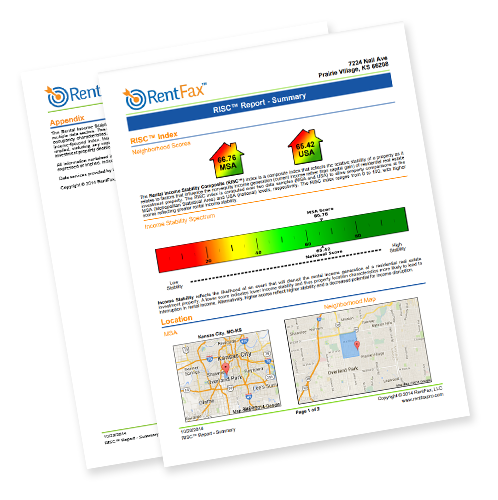
Risk Report
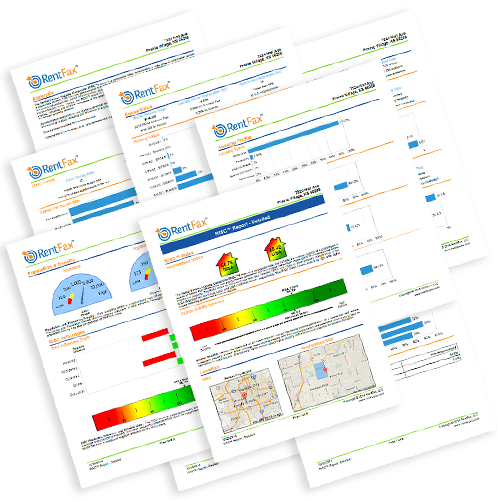
Risk Detailed Report
Run Your First Report Free
Know your risk today before you buy your next rental property.